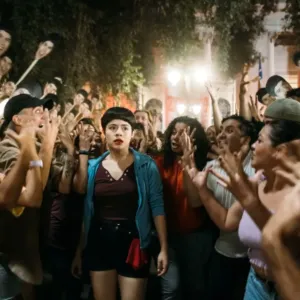
Anchored by a mesmerizing performance from Emma Mackey, Hot Milk is a hypnotic meditation on control, longing, and the elusive nature of freedom.
In her directorial debut, Rebecca Lenkiewicz (Disobedience, Ida) adapts Deborah Levy’s novel Hot Milk into a film that delves into the complexities of family ties and personal identity. Set in a sweltering coastal town in Spain, the film follows Sofia (Emma Mackey), a woman who has built her life around caring for her mother, Rose (Fiona Shaw), whose illness keeps her confined to a wheelchair.
Their relationship is defined by dependency and a subtle form of manipulation. Rose, despite her fragility, remains a possessive presence, while Sofia is trapped in a cycle of silent resignation and bottled-up frustration. Enter Ingrid (Vicky Krieps), a free-spirited and unpredictable woman who disrupts Sofia’s carefully contained existence. More than a simple sexual awakening, Ingrid’s presence becomes intertwined with Sofia’s emotional emancipation.
Mackey delivers a strikingly restrained performance, allowing small gestures—fleeting glances, suppressed smiles—to hint at the turmoil within. It’s a quiet yet powerful portrayal of a woman torn between submission and the urge to break free. Fiona Shaw, in turn, avoids the archetype of the suffering mother, presenting Rose as a complex, sometimes selfish figure who clings to control out of fear.
Where Hot Milk truly shines is in its atmosphere. Lenkiewicz’s camera moves with an intimacy that never feels gratuitous, heightening the film’s emotional and physical tension. Her framing of bodies, open landscapes, and the omnipresent sea reinforces a sense of restrained desire—something simmering just beneath the surface.
If there’s a flaw, it lies in Ingrid’s characterization. While Krieps delivers a compelling performance, the film initially frames her as a near-mythic figure—the enigmatic drifter who arrives on horseback, radiating a mystique that borders on the artificial. Fortunately, Hot Milk doesn’t leave her as a mere symbol of liberation; instead, it allows her contradictions and emotional detachment to surface, adding layers to her character.
One unexpected touch is the presence of Violeta Parra’s music. Gracias a la Vida plays at two key moments, accompanied by Arauco Tiene una Pena, an unusual choice for a foreign production. In an exclusive interview with Mundo Películas, director Rebecca Lenkiewicz shared: «I chose Violeta Parra’s music because I truly love her. I think she was a wonderful singer with an incredible soul, and her life ended too soon. The two songs I picked are extraordinary and deeply moving. I feel like I could listen to her forever.»
Lenkiewicz’s connection to Chile isn’t incidental—she previously wrote Disobedience, directed by Sebastián Lelio, and once again collaborates here with composer Matthew Herbert, whose evocative score enhances the film’s hypnotic tone.

Hot Milk is a restrained yet deeply sensual work—a film of silences, emotional entrapment, and the fraught negotiation between familial duty and personal desire. Lenkiewicz’s directorial voice is assured, favoring nuance over overt dramatization, crafting a film that feels both intimate and unsettlingly honest.